
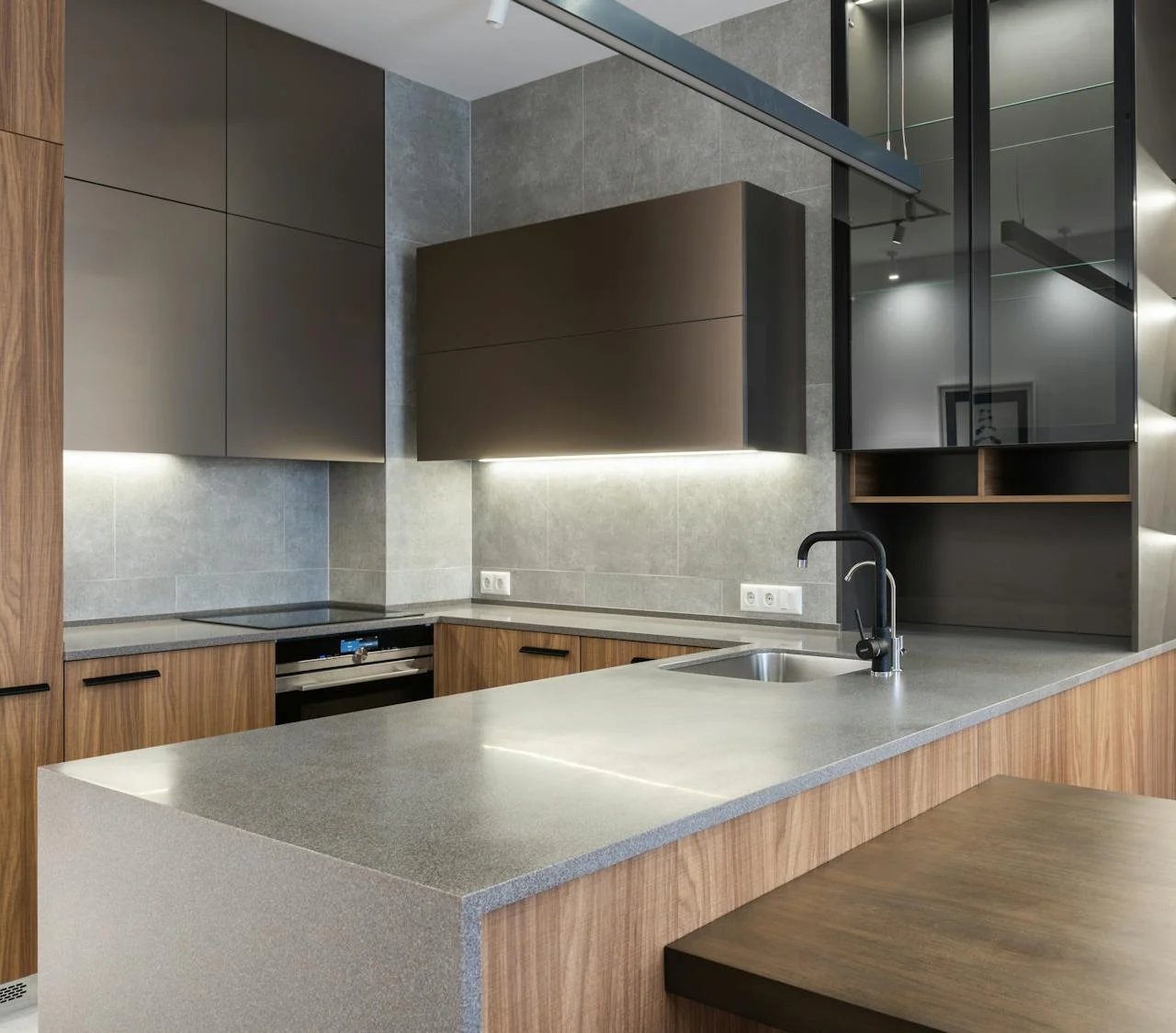
Quartz, granite or marble countertops: how to choose
Choosing between quartz vs granite countertops, or marble, comes down to how you use your kitchen and how much upkeep you are willing to do. Quartz is an engineered surface that is non-porous and resists staining, so it suits busy kitchens and people who want low maintenance. Granite is a natural stone that handles heat well and needs periodic sealing. Marble is the softest and most delicate of the three: it etches and stains more easily and develops a patina over time, which some people love and others find frustrating. Cost overlaps more than most people expect, so the decision is usually about performance and appearance rather than price alone.
Quartz, granite and marble at a glance
Quartz
Quartz countertops are engineered slabs made mostly of crushed natural quartz bound with resins and pigments. HomeStars' countertop installation cost guide describes quartz as known for durability and ease of maintenance, with a non-porous surface that makes it resistant to staining.
- Strengths: consistent colour and pattern from slab to slab, no sealing, easy everyday cleaning, a wide range of colours including marble-look designs.
- Watch for: the resin binder means hot pans should not go directly on the surface; most manufacturers recommend trivets. Some products are not intended for outdoor use or strong direct sunlight, so check the manufacturer's guidance.
- Suits: busy family kitchens, bathroom vanities and anyone who wants a consistent look with little maintenance.
Granite
Granite is a natural igneous stone quarried in slabs, so every piece is different. HomeStars notes that granite does require sealing to maintain its durability.
- Strengths: very hard and heat tolerant, natural variation that no two kitchens share, long service life when cared for.
- Watch for: it is porous to varying degrees, so it needs sealing and spills should be wiped promptly. Pattern and colour vary within and between slabs, which is why choosing your actual slab matters.
- Suits: cooks who want a hard-wearing natural surface and do not mind periodic sealing.
Marble
Marble is a natural metamorphic stone, mostly calcite, prized for its veining and soft, luminous look. It is softer than granite and reacts with acids, so lemon juice, vinegar, wine and some cleaners can leave dull etch marks.
- Strengths: a classic look, cool to the touch (useful for pastry), and a patina that many homeowners value.
- Watch for: etching, staining and scratching. It needs sealing and gentle, pH-neutral cleaning, and it will not stay looking new.
- Suits: homeowners who accept that the surface will change with use, bathroom vanities, or a baking station rather than the main work counter.
What countertops cost
HomeStars' countertop guide gives installed costs, including materials and labour, per square foot:
- Quartz: $55 to $155 per square foot.
- Granite: $40 to $150 per square foot.
- For comparison, laminate is $20 to $80 and butcher block $30 to $150.
The guide does not list marble. Marble prices vary widely by type and origin, so it should be priced from the actual slab you are considering.
For a whole-job reference point, HomeStars' Edmonton kitchen renovation cost guide reports an average of $4,050 for countertop installation, with reported jobs from $500 to $14,000, based on costs as of January 2021. That guide also warns that a stone countertop installed improperly can crack nearby cabinets and walls, which is a reminder that the installation matters as much as the material.
Because the quartz and granite ranges overlap so much, a premium granite can cost more than an entry-level quartz and the reverse. What moves the price within a material:
- The slab itself. Rarer colours and dramatic veining cost more.
- Thickness and edge profile. Thicker counters, mitred edges and waterfall ends add material and fabrication time.
- Cut-outs and layout. Undermount sink cut-outs, cooktop openings, outlets and complex shapes all add work.
- Seams and slab count. A large island may need a second slab or a seam; planning the layout around slab size helps.
- Backsplash. A full-height slab backsplash in the same material is an attractive but significant addition.
How to choose for your kitchen
Be honest about how you cook. If the counter takes hot pans, tomato sauce and children's art projects, quartz or granite will be more forgiving than marble.
Decide how much maintenance you want. Quartz needs no sealing. Granite and marble do, and marble also needs care with acids.
Choose the look: consistent or one of a kind. Quartz gives predictable colour and pattern. Natural stone gives variation, so view the actual slabs.
Consider the whole room. Countertops work with cabinets, flooring, backsplash and lighting. Choosing them together, as part of interior design and selections, avoids combinations that compete.
Plan the layout before the slab. Where the seams fall, the size of the island and the sink and cooktop positions all affect both the look and the cost.
Many kitchens mix materials: a hard-wearing quartz on the perimeter and a statement stone on the island, or a natural stone island with a custom millwork feature. Mixing can give you the look you want where it is seen most, with practicality where you work hardest.
Bathrooms and vanities
Bathroom vanities take less abuse than kitchen counters, which is why marble is more practical in a bathroom than in a kitchen. Even so, cosmetics, hair products and some cleaners can mark marble, so quartz remains the low-maintenance choice for a busy family bathroom. If a new vanity top is part of a larger bathroom project, our guide to bathroom and ensuite renovation costs in Edmonton explains where the countertop fits in the overall budget, and our bathroom renovation page covers how we plan the room.
Countertops as part of a renovation
New counters are often the most visible part of a kitchen renovation, but they are also one of the last things installed. Stone is templated once the cabinets are in, then fabricated and installed, so countertop selection needs to happen early even though installation happens late. If you are only replacing counters on existing cabinets, check that the cabinets are level and sound enough to support stone.
If you are still deciding how big a project to take on, our posts on small renovation upgrades that make a big impact and renovation trends in Edmonton for 2026 are useful starting points. You can also browse our recent projects.
Frequently asked questions
Is quartz or granite better for a kitchen?
Neither is better in every kitchen. Quartz is non-porous, resists staining and needs no sealing, which suits busy households. Granite tolerates heat well and offers natural variation, but needs periodic sealing.
Is quartz more expensive than granite?
Not necessarily. HomeStars lists quartz at $55 to $155 per square foot installed and granite at $40 to $150, so the ranges overlap. The specific slab, edges, cut-outs and layout matter more than the material name.
Is marble a good choice for a kitchen countertop?
It can be, if you accept that marble will etch, stain and develop a patina with use. Homeowners who want a surface that stays looking new usually choose quartz, including marble-look quartz.
Do quartz countertops need to be sealed?
No. HomeStars describes quartz as having a non-porous surface that resists staining. Granite and marble are natural stone and do need sealing.
Choose with the whole kitchen in mind
Countertops are easiest to choose alongside the cabinets, lighting and layout. Our team, led by founder and lead builder Courtney Parr, works with homeowners across Edmonton and communities such as Leduc. Book a consultation and we will help you weigh the options for your kitchen or bathroom and include them in a detailed quote.